


Cultivating Questions: Carbo-Loading the Soil
Cultivating Questions
Concerning the Bio-Extensive Market Garden
by Anne & Eric Nordell of Trout Run, PA
Carbo-Loading the Soil
Dear Anne & Eric,
Thank you for the letter you sent us dated March 3, 2005. It was just the encouragement we needed. Now that the growing season is winding down, you might have time to read this, how about it?
We hope you have had a good summer, with enough rain to keep things growing.
I want to tell you how our summer has been, if you can bear with me. All in all we’ve had an enjoyable time and many blessings from above. As you can imagine, we’ve made some mistakes amid our successes.
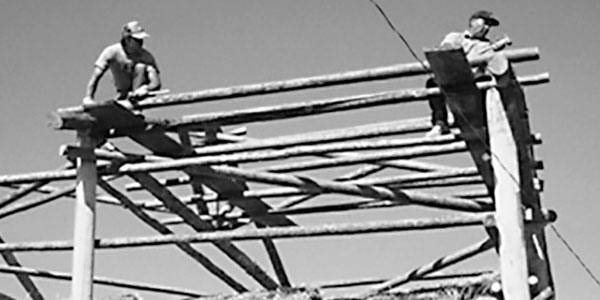
In the middle of March I built a roadside stand here at our house with plans to plant a little extra of everything in hopes of selling everything at home, and hopefully to increase, yearly, our produce sales and work, while decreasing work in other areas of our life. I built the stand out of round timbers right out of the woods with board and batten siding, a porch, and wooden rain gutters, giving it a rather rustic and unique look.
As it turned out, some of the most time-consuming things did not sell well, such as snap peas and salad ingredients, while others we should have planted much more. We have found the biggest demand was for strawberries, tomatoes, sweet corn and melons, all of these being less suited for your climate, no doubt. We also have 250 blackberry plants started, in hopes of establishing a market for them.
We did have the driest summer we’ve had since living in this area. Lots of thundershowers passed north of us, so I assume you got some of those. In the middle of July we had only one week of cloudy, drizzly weather and 1 ½” of rain, then practically nothing until the last week of August, 9/10”, and now several inches from hurricane Katrina. We did some irrigating by hand, but our produce was still less than average in size.
I did make a big mistake that affected us all summer to our embarrassment as our garden is visible from the road. Last fall, in early August, I plowed and sowed this garden plot to sorghum-sudangrass and oats. I didn’t sow hairy vetch because I have small grains in my rotation. As you probably know, this vetch can wreck havoc in small grains, that is, volunteer vetch.
This mixture produced excellent biomass and winter cover. In the spring I tilled it in with some compost. The compost was probably of low quality, at least low nitrogen, as I later guessed. I thought the soil had very good tilth and much less weed pressure, BUT, everything we planted seemed to be very slow growing. I kept assuring my wife, Edith, that it’ll come along all right after a while. But no, it just wasn’t as vigorous as most other gardens in the area. As we did no soil analysis or compost analysis, we aren’t sure what the problem was, but can only guess the carbon overpowered or tied up the meager nitrogen supply.
So we still have much to learn and appreciate any advice that comes our way. We feel we have had enough of a success to try again next year, and to always try to do better.
Sounds like you folks have lots a-going, according to SFJ.
Best wishes to you,
Titus and Edith Martin
Watsontown, PA
We, too, have learned the hard way that overloading the soil with carbon can lead to poor crop growth due to nitrogen tie-up. For example, our usual practice during the first years on the farm was to plow in after harvest crops, like garlic and strawberries that were heavily mulched with wheat straw. We plowed deeply and completely in order to make it easier to seed the following crop. Much to our dismay, the following crop really suffered, looking pale green and stunted. Fortunately, in this case, the nitrogen deprived plants were a fallow year cover crop of rye, not high-value vegetables.
Since vigorous, fallow year cover crops are essential to our soil building, weed depleting system, we needed to find a way to prevent nitrogen tie-up in the rye. We decided to try tilling the heavily mulched small fruits and vegetables as shallowly as possible, and, when possible, allow six weeks of decomposition before establishing the rye. The idea being “mulch tilling” was to keep the decay process in the top two inches of the soil in order to prevent microbial competition for nitrogen in the root zone of the fall planted cover crop. Whether or not this is what actually takes place in the soil, nitrogen tieup has not been a problem since we began shallowly tilling the crops mulched with wheat straw. In fact, yesterday we mowed a vigorous, six foot tall cover crop of pollinating rye that was planted after mulch tilling last year’s heavily mulched no-till garlic.
We now use the same strategy for growing market garden vegetables on a high carbon diet. We just make sure to till the high carbon cover crop, mulch materials or coarse, strawey compost as shallowly as possible and initiate decomposition at least five-to-six weeks ahead of planting the produce.
The “Weed the Soil” DVD highlights the surface tillage techniques that we use with the horses, including skim plowing, mulch tillage, ridge-till and notill. We know of tractor farmers, both vegetable and grain growers, who have achieved the same results by simple discing, undercutting or rotovating the soil no more than 2-3” deep.
Keep in mind, that mulch tilling to prevent nitrogen tie-up may not be appropriate for heavier, poorly drained soils that require deep mechanical loosening to provide adequate soil aeration and warming. Likewise, land in transition to biological management may not be the best candidate for mulch tilling high carbon inputs. Instead, a low-carb diet may be the better prescription until the soil life regains its powers of digestion. Fine, finished composts, small grain cover crops at the succulent, immature stage, and pure stands of legumes may be the best recipe for success during the first years of transition from conventional to organic management.
When we received Titus and Edith’s letter in September of 2005, we had just completed our first season experimenting with a new fallow year cover crop mix of sorghum-sudangrass (aka sudex) and medium red clover. Now, after four years of experience, we think this combination holds promise for carbo-loading the soil without causing nitrogen tie-up. And we think it should work for land in transition or farms with heavier, clay soils.
We got the idea for this novel mixture of sudex and clover from the profile of Eileen Droescher’s Ol’ Turtle Farm in Seth Kroeck’s excellent manual on Crop Rotation and Cover Cropping (see sidebar). We were not only intrigued with the pairing of a warm season, C4 carbon-fixing cover crop with a cool season, C3 nitrogen-fixing legume, but the ideal planting date of mid-June for this mix fit in nicely with a spring bare fallow period targeting cool season weeds and insects.
The key to managing the super-sized sudex is mowing it two or three times over the course of the summer. Clipping it when three to four feet tall keeps the residues manageable and succulent for more rapid decomposition. Otherwise, the sorghum-sudangrass can grow over ten feet tall and turn as tough as old corn stalks – a sure recipe for nitrogen tie-up!
By carbo-loading the soil with lots of succulent sudex the year before vegetable production, much of the decomposition has already taken place on the soil surface before the crops even go in the ground. Plus, a plowdown of the overwintering clover adds extra nitrogen to help complete the decay process. We have not seen any evidence of nitrogen tie-up following this cover crop mixture and we suspect it will work just as well for land in transition or for heavier soils that require deeper tillage, especially if some compost is added and planting is delayed for at least a few weeks.
We continue to use shallow tillage with this new cover crop combination for site-specific reasons, such as fiberizing our silty, crust-prone soils and for preserving moisture for growing vegetables without irrigation. Really, we think the deep root system of the sudex and clover enhances shallow tillage. At least, we have noticed improved drainage and infiltration in the heavier parts of our fields following this cover crop mix even when tilling just the top two inches of the soil.
We don’t want to give readers the impression that sudex and clover are some kind of miracle cover crop cure for whatever ails the farm. To the contrary, there are a number of drawbacks which may deter growers from adopting this mix, above and beyond taking land out of production for most of a season to grow it. First, is the expense of the seed. This year a 50-pound bag of organic sorghum-sudangrass seed cost us $70; $190 for the organic medium red clover. At a weed competitive, broadcast seeding rate of 45-50 lbs. of sudex/acre and 20-25 lbs. clover, we are spending close to $150 just in cover crop seed per acre!
As for growing requirements, sudex is a heavy feeding crop and requires high fertility for peak biomass production. It may not be the best choice for reviving low fertility soils or for following nutrient demanding cash crops. It may also be a poor choice for cool, moist climates as this corn-like cover crop prefers hot, dry conditions. For the first three years of trialing this new cover crop mix, the sorghum-sudangrass consistently produced two-to-three heavy cuttings of carbon-rich biomass. Last year, however, regrowth after the first clipping was minimal due to the cool, wet weather.
Regarding the cash crops, the main drawback of the sudex is its root clumps take a long time to decay and tend to get stuck between the planting shoe and coverer of our Planet Jr. seeder. We solve this problem by delaying planting of direct seeded crops until the sudex stumps have completely decomposed, by rigging up a row cleaner to move the root clumps out of the planting row, or by doing a clean job of plowing and being careful not to bring the sudex stumps back up to the surface.
The clover roots decompose extremely quickly, causing no problems for seeding. The main challenge with clover, at least on our farm, is that brassicas planted after it seem to be much more attractive to flea beetles. Fall broccoli, cabbage, collards and kale transplanted following a plowdown of sudex stubble and red clover typically require three sprayings of Entrust to get them through the early, vulnerable stages of flea beetle pressure, while the same crops, planted the same day after a cover crop of rye and hairy vetch, need only one treatment of Entrust, if that. Otherwise, the fall brassicas are just as productive and healthy following the sudex-clover mix.
Despite these drawbacks, this novel cover crop combination has earned a permanent place in the bio-extensive rotation because of the dramatic reduction in cool season weeds, like chick-weed and henbit, the superior size and uniformity of root crops, especially the carrots, and the added flexibility of spring field management. Compared to other overwintering cover crops, like rye and vetch, the clover grows much more slowly in the spring and is much easier and faster to transform into a seedbed – good options to have in a wet April and May. If the weather were to turn really uncooperative, it is nice to know we always have a couple of clover-sudex fields that do not require shallow tillage or six weeks of decomposition to prevent nitrogen tie-up.
Before closing this column on carbo-loading the soil, we need to state what might be the obvious: pale, stunted crop growth can be caused by other factors than nitrogen tie-up due to much carbon. Cold, wet soils can result in nitrogen immobilization even without an imbalance in carbon and nitrogen. Likewise, anything that injures the roots of the vegetables will restrict nitrogen and other nutrients from flowing into the plant. That is, root diseases and insects, not to mention mechanical injury, may be the problem, not nitrogen tie-up. On our farm, slug and grub damage to crop roots in the spring cause very similar symptoms initially to overloading the soil with carbon. This has been less of a concern since depriving these cool seasons, ground dwelling bugs of food and habitat with a spring bare fallow before planting summer cover corps, like the sorghum-sudangrass and medium red clover.
N immobilization. In Chapter 2 you learned that N may be tied up in the soil following a high-carbon cover crop or residue situation. Low N generally will not affect germination, as seeds come with their own kick-off supply, but it could cause poor early growth, with yellow, and possibly stunted plants. If your cover crop is high in carbon and low in N, supply some form of starter N, either as some proportion of legume in the cover crops, or as fertilizer N, placed so that germinating seed can access it easily, to hold the young plants over until the microbes start to croak and give up their N. Also, remember that non-legume cover crops will not supply any N to the soil, only recycle what is already there…
C:N ratios. One way to express the amount of available energy in plant residue relative to the N available for cell-building is through the carbon:nitrogen or C:N ratio (carbohydrates and sugars are largely composed of carbon). When the C:N ratio of plant residues is greater than about 25:1, immobilization is likely because all that carbon can sustain a lot of party-goers (microbes). The higher the C:N ratio, the longer the immobilization is likely to last.
Most fresh, non-woody legume residues contain between 10:1 and 15:1 C:N, so immobilization is not likely, unless a lot of high C:N material such as wheat straw, with a C:N ratio closer to 80:1, is also present. Fresh grass clippings would typically have a C:N ratio in the range of 20 to 30:1, so some immobilization may take place when grass cover crops are turned into the soil. Immobilization is not only more likely at high C:N ratios, it will also last longer.
Woody materials have a high C:N ratio (as high as 400:1) but also a high lignin content. As mentioned earlier, lignin is resistant to quick microbial decomposition, so the woody material will not cause the type of rapid microbial population increase seen in more succulent materials. Instead, woody materials will tend to tie up a smaller pool of N but for a much longer time.
In order to know whether immobilization is likely, you need to know an approximate C:N ratio for the organic materials (cover crop plus any manure and crop or weed residues) you are adding to the soil. Below is a chart listing approximate C:N ratios for some common organic materials…
When turning down a material with a high C:N ratio, it may be worthwhile to give plants some starter N with the seed or transplants to avoid possible short term N deficiency. Mulching with high C:N material such as straw or wood chips may tie up N right at the soil surface but generally will not affect N below the top few inches.
Average C:N Ratios of Common Organic Amendments
| Alfalfa Hay | 13:1 |
| Leaves | 40-80:1 |
| Cornstalks | 60:1 |
| Straw | 80:1 |
| Ryegrass (fresh) | 25:1 |
| Cereal Rye (young) | 14:1 |
| Cereal Rye (flowering) | 20:1 |
| Sawdust | 400:1 |
| Vegetable Wastes: Leaves, Stems, Fruits | 12-40:1 |
| Roots | 25:1 |
| Manure (raw, no bedding) • Swine, Beef, Dairy • Sheep • Poultry | 16:1 10-12:1 10:1 |
-Marianne Sarrantonio
Northeast Cover Crop Handbook
Rodale Institute
available from FEDCO
www.fedcoseeds.com
Wiley Grass Farm (Schoolcraft, MI)
Matt Wiley
Certified Organic since 1999
Acreage: 240 Field Crops
Soil Type: Kalamazoo loam
Typical Yearly Precipitation: 32 inches
Rotation details
Year 1: Medium red clover is incorporated around April 25 about 2 ½ inches deep using a rotovator. In early May the field is then worked again with the rotovator and then harrowed just before planting. Fish emulsion is applied at corn planting and then side-dressed once. In the fall after harvest, lime and chicken manure are applied and rye is planted for the overwinter cover crop.
Year 2: The rye is tilled in late April to about 2 ½ inches and again in early May. It is then harrowed just before planting snap beans. Four days after planting, the beans are weeded using a tined weeder. The rotary hoe follows three times at a four day interval. The crop is then cultivated two times. Spelt is planted after harvest.
Year 3: Clover is frost seeded into the spelt in March. After spelt harvest in late July the stubble is mown to reduce annual weeds and to allow for even growth of the clover. In the fall chicken manure (2 tons per acre) and lime (500 lbs. per acre) are applied over the clover.
Year 4: Same as Year 1.
Year 5: Same as Year 2, only with soybeans instead of snap beans.
Year 6: Same as Year 3.
Benefits of this rotation
- Weed pressure has decreased and yields have increased.
- The soil is less compacted with the shallow tillage and it holds moisture better.
Issues in this rotation
- Snap beans and soybeans need to be harvested by early to mid- September so that spelt can be planted on time.
-from Integrated Weed Management: Fine Tuning the System by Erin Taylor, Karen Renner and Christy Sprague, Michigan State University Extension Bulletin E-3065, www.emdc.msue.msu.edu
Elieen Droescher
Ol’ Turtle Farm
Easthampton, Mass
Land in rotation: 12 acres
For the membership of her CSA, Eileen grows an extremely diversified mix of vegetables and fruit crops on 14 acres in the Connecticut River Valley. Of those, 12 are in rotation with the other two planted to cane fruit. She has devised a rotational plan that allows her to maximize production levels on her farm (supplying food for 200 families through the CSA) while still meeting her goal of devoting half of her rotated acreage to cover crops during each season.
The fields at Ol’ Turtle Farm are organized in a permanent bed system and tilled with a spader that is the same width as the beds. This system allows Eileen to know exactly where a crop was sown in any given year and till in covers and cash crops one bed at a time – ensuring a seamless succession between the two. Her rotation is based on a few large units: 30 beds (each one 300 ft. long) make up a single unit. For diversity in the field, Eileen has designed her plantings so that each unit of 30 cash crop beds is separated from the next by 30 beds of fallow covers. This patchwork pattern allows for beneficial insect habitat next to cash crops and helps maintain a protective distance against disease and pests between successive plantings of the same cash crop. Two examples Eileen cites are squash and tomato that are susceptible to mildew/ blight problems as the season progresses.
Using large units subdivided by permanent beds allows Eileen to create a rotation within each one in any given season, varying the location of crops easily among the 30 beds. This flexibility also maximizes her ability to change details like the size of a planting or its location for ease of harvest from year to year. Good record keeping and permanent beds allow her to avoid planting families in the same location for at least four years.
The basic rotation of covers and cash crops at Ol’ Turtle looks something like this:
year 1 oats/peas
year 2 cash crops
year 3 sudex/red clover or millet/red clover
year 4 cash crops
year 5 rye or rye/vetch
year 6 cash crops
-Seth Kroeck
Soil Resiliency and Health: Crop Rotation and Cover Cropping on the Organic Farm
NOFA Handbook Series on Organic Principles and Practices available for $9.50 (includes s&h) from NOFA-NY, Inc., PO Box 880, Cobleskill, NY 12043-0880